
Fighting Authoritarianism in Our Third Act. On the historical moment we currently occupy, the concept of an Authoritarian Breakthrough, and what can be done in the window of time when authoritarians are trying to seize power from democratic institutions.
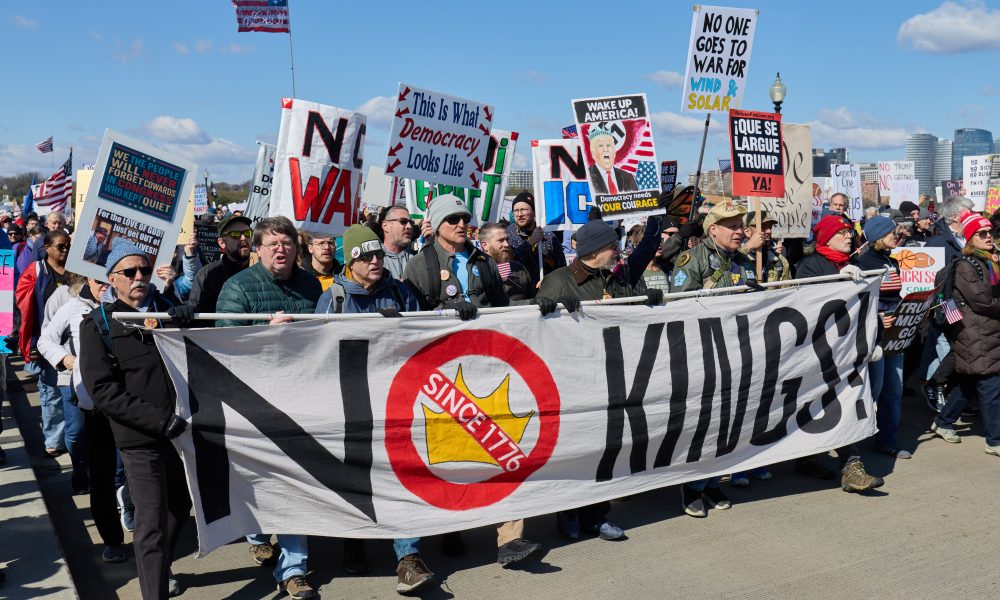
We’re living through something that historians have a name for: an authoritarian breakthrough. This is a short window in which a would-be authoritarian regime attempts to rapidly consolidate power, eliminate checks on said power, and operate with impunity. Our institutions haven’t collapsed. Our systems haven’t completely broken down. But let’s make no mistake: breakdown is absolutely the goal of this administration, and they’re moving as fast as they can.
What we’re experiencing is not unique to the United States, nor is it random. Authoritarians around the world follow a playbook. They stoke fear and chaos to keep people off balance. They make threats to compel people to obey in advance — the constant flood of executive orders, the tariffs, the ICE raids, the nuclear saber-rattling. They weaponize fear of subgroups to keep us divided. And, critically, they make life materially harder for everyone who isn’t a billionaire or a member of their inner circle, because economic insecurity is one of the most effective tools for suppressing resistance. When you’re working two or three jobs to make rent, you can’t afford to lose one of them. You can’t strike. You can’t show up to meetings. You can’t build the relationships with neighbors that movements are made of. Dismantling unions and labor protections isn’t a side effect of authoritarian rule — it’s a core feature of it.
The data tells a stark story. Authoritarian regimes generate four times as many economic crises. They spend 50% less on social protections like healthcare. They produce twelve fewer years of average life expectancy and 62.5% higher infant mortality rates. They invest less in education and exhibit 40% more corruption. What we’re watching unfold, from the gutting of Medicaid and SNAP, to the attacks on the Department of Education, to the brazen self-enrichment of the Trump family, isn’t a series of failures or accidents. It’s the design.
The Good News
Here’s the thing about democratic backsliding: it isn’t always fatal. In 96 documented episodes from 1900 to 2019, 68% did collapse into full authoritarian rule. But over the last 30 years, more than half of countries that experienced democratic breakdown managed to turn things around — becoming not just what they were before, but more democratic than they had been. Not a return to the status quo that wasn’t working, but something better.
Civil resistance movements dramatically change the odds. Research by Erica Chenoweth and Maria Stephan, studying 35 cases over 30 years, found that without a civil resistance movement, there was roughly a 7.5% chance of stopping an authoritarian takeover. With one, the chances rose to 51.7%. That’s not a guarantee — I want to be clear that it’s basically a coin flip, and we have a lot of work to do. But it tells us something essential: what we do matters enormously.
Chenoweth’s research also established that when 3.5% of the population engages in sustained strategic escalation, those movements win. I want to emphasize that word: sustained. This isn’t about showing up once. It’s about 3.5% of Americans consistently, actively building the resistance over time. And given that authoritarians have also been studying and adapting to these findings, I think we should treat 3.5% as a floor, not a ceiling.
Right now we are in what organizers call the transition from Stage One, gathering strength, finding each other, forming new communities and alliances, to Stage Two, typified by cycles of interference where small groups practice different forms of action, experiment with tactics, and figure out what works). What makes movements succeed at this stage, the research tells us, is large and diverse participation across sectors, a commitment to managing tensions and staying together, active work to shift loyalties, and — crucially — a commitment to nonviolent discipline. Civil resistance movements that remain nonviolent are more likely to win, because more people are willing to join them.
The Tools: Non-Cooperation
So what does this actually look like in practice?
It’s worth separating out three distinct kinds of action. Symbolic actions — marches, vigils, letter-writing — are vital for bringing more people into the work and demonstrating the scale of opposition. But under authoritarianism, they become less effective at moving political targets, because authoritarians simply don’t care if people march in the streets.
Alternative cooperation — building new institutions to meet needs the current system won’t, like mutual aid networks, the modern Underground Railroad supporting migrants and trans people targeted by the administration, or the National Network of Abortion Funds stepping in where Planned Parenthood has been defunded — is building the world we want to see while disrupting the one we’re resisting.
But the tool I want to spend the most time on is non-cooperation: the act of refusing to cooperate or comply with requests, demands, or orders from an unjust system — and doing so in enough numbers that entire pillars of that system begin to crack.
Non-cooperation scales. It starts at the individual and small-group level — your choices, your refusals, your community. It grows to collective action, where those small groups link up and coordinate. And at its most powerful, it becomes mass non-cooperation: millions of people who previously bought a product all agreeing to boycott a company, hundreds of thousands of kids refusing to go to school, millions calling out sick.
We’re already seeing it work. This year alone, a coordinated boycott of Avelo Airlines — which was contracting with ICE — got them to drop that contract. The Tesla takedown sent the company’s sales plunging 13% globally and cratered net income 71% in a single quarter. Enough Spotify subscribers canceled their accounts over ICE ads that the platform reversed course.
The Pillars of Support
To understand why any of this works, you need to understand how power actually functions. Political theorist Gene Sharp put it beautifully: rulers, by themselves, cannot collect taxes, enforce laws, keep trains running, print money, train the police, build rockets, or even milk a cow. They depend on a network of institutions and the people inside them to do all of that. If enough of those people stop cooperating, the ruler cannot rule.
We call these institutions the pillars of support: business, labor, faith communities, educational institutions, civil service, the military, law enforcement. Each pillar is made up of different layers of people — and the outer layers, the ones with the most people, are where movements have the most leverage. There are far more soldiers than generals. Far more workers than CEOs. People power, at scale, is the strategy.
One of the most striking examples of this in practice is the story of OPOR, the student resistance movement in Serbia during the Milosevic era. OPOR started small, in 1998. They were regularly beaten by police. And yet they made a decision that changed everything: they targeted the military as their long-term strategic goal, because they knew that without the military’s cooperation, Milosevic couldn’t hold power. They handed flowers and t-shirts to police officers. On National Days of Mourning — the Serbian equivalent of Veterans Day — they read the names of fallen officers alongside those of their own people killed in the struggle. They were planting seeds over years. At actions, they would repeatedly say to police officers and soldiers, “You will have your chance to join us.” When they were arrested, they wouldn’t fight back — instead repeating, “We understand that it’s not your choice to arrest us. You were forced by the regime. We don’t hold a grudge.” When Milosevic stole the 2000 election, the protesters who converged on the parliament building faced soldiers ordered to fire on the crowd. The soldiers refused. They opened the gates. They joined the people.
You don’t have to be a member of a pillar to influence it. If you’re not in the military, not in law enforcement, you can still work to shift those loyalties — through relationships, through persistent outreach, through making it clear that there is a place for people who choose to defect from an unjust system.
A useful tool for thinking about this is the spectrum of allies: active allies already working alongside us; passive allies who agree but haven’t acted; the neutral middle; passive opponents who disagree but aren’t actively working against us; and active opponents. The strategy is always to move people toward engagement while isolating the active opposition. Every person you bring from passive to active on our side is a win. Every person you shift from neutral to passive ally is a win. And in order to get to the scale needed to win, everyone needs to be an organizer. Everyone needs to bring more people into this work.
Lessons from Minnesota
I want to focus on one example from the recent past that I think holds some of the most important lessons for where we go next.
On January 23rd of this year, Minnesota experienced what has been called the first general strike in the United States in 80 years. Under the banner of “No Work, No School, No Shopping,” nearly one in four Minnesotans participated in a one-day strike after ICE escalated its operations in the state — an escalation that had turned lethal with the murder of Renee Goode, an unarmed civilian, by an ICE agent.
One hundred thousand people took to the streets in Minneapolis in negative nine degree weather. Over a thousand businesses closed. Workers in 215 other cities walked out in solidarity. One hundred faith leaders and clergy were arrested alongside protesters blocking Terminal 1 at the Minneapolis airport.
I want to be honest about what that action did and didn’t accomplish. It was not designed to collapse the pillars. It was a show of force — a demonstration of scale, a flexing of collective muscle. And it had real effects: “ICE Out” became a nationwide rally cry that even mainstream media couldn’t ignore. Key voices in law enforcement, including the Hennepin County Sheriff, publicly condemned ICE tactics (“We are traumatizing these kids. We are robbing them of their futures.”). Financial reporters started publicly asking corporations which side they were on. Cities like Philadelphia and the state of Maryland moved legislation restricting ICE activity. Local schools documented that 1 in 6 students didn’t attend that day.
What made it possible? It didn’t come from nowhere. We don’t get Minnesota without George Floyd’s murder and the organized response of Black Lives Matter. We don’t get it without years of local organizing, and without hard-won lessons from Los Angeles, DC, Memphis, New Orleans, Chicago, Portland, and dozens of other places. The trust, the relationships, the mutual aid networks, the Signal groups, the early alert systems — all of that was already there. Courage, when it showed up that day, was contagious because community had been built first.
What Comes Next
A word here that I think is important: we can’t be too judgmental about where people are in this process. The Montgomery Bus Boycott lasted nearly a year and required extraordinary logistical support — carpools, fundraising, mutual aid, legal defense — none of which appeared overnight. People are learning how to do this. They’re learning how to be in the streets, and how to sustain action after they leave the streets. We have to meet people where they are and bring them along.
For those of us in our Third Act — people who have decades of experience, skills, relationships, and often more time than our younger counterparts — there are particular ways we can contribute. We can support strike funds, which are lifelines for workers who can’t afford to lose a paycheck. We can support businesses that take a stand by being their customers the day before and after they close. We can choose not to spend money on strike days as our own form of participation. And perhaps most importantly, we can be the trusted information hubs in our communities — the neighbors people turn to instead of turning on cable news or scrolling Facebook, the voices that build trust and counter disinformation through genuine relationships.
This is long work. It doesn’t end with any single action or any single election. But the data is clear: when movements build enough scale, sustain nonviolent discipline, cultivate solidarity across sectors, and work systematically to shift the pillars of support — they win.
Kendall Mackey
Kendall Mackey is a trainer with Freedom Trainers, a national network that has trained over one million people in non-cooperation and non-compliance. This piece is adapted from a training session presented in the “Fighting Authoritarianism in Our Third Act” series.
Share This


Ways to get involved
All the different ways you can get involved with Third Act:


