Nancy LaPlaca sets the record straight on solar energy.

Over the past decade or so, the cost of solar has dropped 90%, while land-based wind electricity has dropped 70%. Solar can be cost-effectively installed pretty much anywhere in the U.S., and solar beats 99% of the coal plants in the U.S. on cost—that’s because solar has no fuel costs, no clean-up of toxic wastes, no need to dig up, and no need to extract or transport fuel.
Solar and wind produce zero pollution and zero carbon, and create far more jobs per dollar spent than fossil fueled electricity. Local rooftop solar creates 30 times more jobs than large, utility-scale solar. While the fossil fuel industry touts methane gas (also called natural gas or fossil gas) as “clean,” the truth is that methane gas is a stunning 86 times worse for the climate than CO2 from burning coal and is a “super-pollutant.” Many experts believe that our rapid recent increase in global temperatures is due to methane gas.
Batteries are now on the same steep cost decline curve. The number of solar customers who add batteries was up over 30% in 2024, and as more of us experience grid outages due to extreme weather, that number will continue to rise.
These are just a few of the reasons why Third Act believes in the power of clean energy. Still, myths about solar and clean energy persist. As clean energy grows in popularity and threatens fossil fuel dominance, misinformation is increasing—but we’re here to set the record straight.
❌ Myth #1: A renewable energy grid is unreliable.
There is a persistent myth that renewable energy is not as reliable as methane gas, but grid outages over the past two decades have shown otherwise.
From 2013 to 2024, the U.S. had five separate large-scale grid outages. Blackouts during Winter Storm Uri in Texas affected 4.5 million people and cost an estimated $195 billion in damages. A joint analysis of Storm Uri by two federal agencies concluded that 73% of electricity failures were due to coal and methane gas power plants. Simply put, extreme weather froze equipment, disrupted fuel supplies and caused staggering increases in the cost of electricity all across the U.S., from Texas to Minnesota to Tennessee and North Carolina.
Fossil gas has also proven unreliable in heat waves. The Federal Energy Regulatory Commission (FERC) studied a series of grid outages that occurred in 2021 across Texas and the south central U.S. These outages were triggered by an extreme cold weather event that caused widespread and long-lasting power failures, resulting in over 200 deaths in Texas alone. The study concluded that 58% of the total electric generators that failed were methane (“natural”) gas, 18% were coal, 22% were wind, and only 1% solar.
There’s a reason that 46% of new electricity brought online globally in 2024 was solar—it’s the cheapest electricity on Earth.
❌ Myth #2: Solar can’t support year-round energy needs.
While solar by itself can’t produce electricity when the sun is down, batteries are solar’s superpower, allowing the sun’s energy to be stored and used anytime.
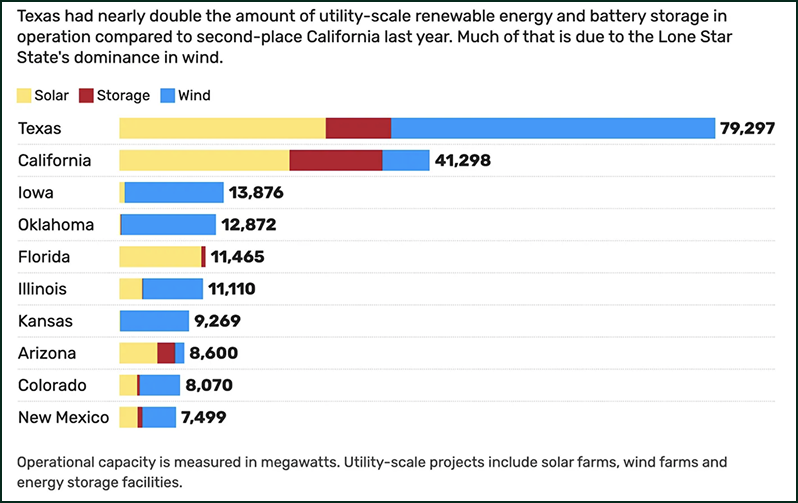
In sunny California, wind, water, and solar has supplied 100% of grid power for 56 out of 88 days so far this year, with methane gas use down ~30% over a few years. In Texas, the amount of solar (and batteries) added to the grid in the past 2–3 years dwarfs even California’s longtime solar dominance. Texas now has nearly twice as much combined solar, wind, and batteries as the Golden State. Solar—plus batteries—on Texas’s grid have fixed the outage problem, so customers can avoid unexpected, enormous rate increases due to fuel costs.
There’s a reason that 46% of new electricity brought online globally in 2024 was solar—it’s the cheapest electricity on Earth. In the U.S. in 2024, 99% of electricity brought online was from clean energy.

❌ Myth #3: We don’t have enough land.
Mining, refining, transporting and burning fossil fuels requires a lot of land. Building 100,000 megawatts (MW) of solar in TX would require 0.5% of its land. Studies show that committing to 100% wind, water, and solar in the U.S. by 2035 would require less than half the area currently used by oil and gas leases. Decarbonizing electricity would require less than 1% of the total land area in the U.S.
Solar electricity—unlike coal, methane gas, or nuclear power plants—requires no water and does not generate either solid waste or toxic emissions.
❌ Myth #4: We don’t have the right technology.
There are “no miracles needed,” according to long-time clean energy expert Dr. Mark Jacobson—solar, wind, hydro and batteries can supply all the electricity we need. While the last 10% of fossil fuel-use will be more difficult to replace, the vast majority of electricity use in the U.S. can be covered by clean energy resources. Over the past decade, the cost of clean energy has plummeted: solar is down 90%, wind 70%, and batteries more than 90%. Solar electricity has been the cheapest electricity on Earth since 2020, and in sunny states, it’s a no-brainer—unless you’re in the business of selling fossil fuels for electric power plants.
The problem is not that our technology isn’t up to the task; it’s that far too many states and utilities have rules that are killing clean energy. As Al Gore says, while the fossil fuel industry isn’t very good at capturing emissions, they are good at capturing politicians and regulators.
Clean energy won’t kill jobs, it will create jobs: an estimated 400,000 new jobs alone from the Inflation Reduction Act of 2022.
❌ Myth #5: Renewable energy will kill jobs.
Renewable energy creates far more jobs than fossil fuels.
One study estimated that solar photovoltaic (PV) creates 1.5 times more jobs per investment dollar than fossil fuels. A global study showed that renewable energy creates three times as many jobs as fossil fuels. Clean energy also creates more jobs per MWh of electricity generated than fossil fueled power plants. Solar energy is labor intensive, and can employ a lot of people.
Half of all clean energy jobs don’t require a college degree, and most pay more than the national median salary. Fossil fuel jobs are decreasing due to the cost advantages of solar and wind, as well as mechanization. In other words, the coal industry once employed nearly a half million people, but giant machines that dig for coal displaced a huge percentage of coal miners.
Clean energy won’t kill jobs, it will create jobs: an estimated 400,000 new jobs alone from the Inflation Reduction Act of 2022. Globally, clean energy is skyrocketing, with solar increasing by leaps and bounds, and batteries on a steep upward trajectory. Clean energy accounted for 87% of new electricity jobs in 2022.
Another report concluded that the energy transition will offset lost fossil fuel jobs, and a new clean energy manufacturing boom in the U.S. is also creating jobs.
❌ Myth #6: Renewable energy is too expensive.
Since 2020, solar electricity has been considered the cheapest electricity on Earth.
More recently, the cost of batteries has come down so far so fast that it’s beating fossil fuel generators on cost in Texas, California, and many other states.
In just a few years, the state of Texas installed jaw-dropping amounts of solar. Why? Because solar beats methane gas on cost by a country mile, due to the often-skyrocketing costs of methane gas fuel. Over 12 years, solar and wind have saved Texans $28 billion in methane gas fuel costs. On sunny and windy days, clean energy has saved Texans $10 to $30 million per day. Some utility customers will be paying for methane gas fuel price spikes for the next 16 years!
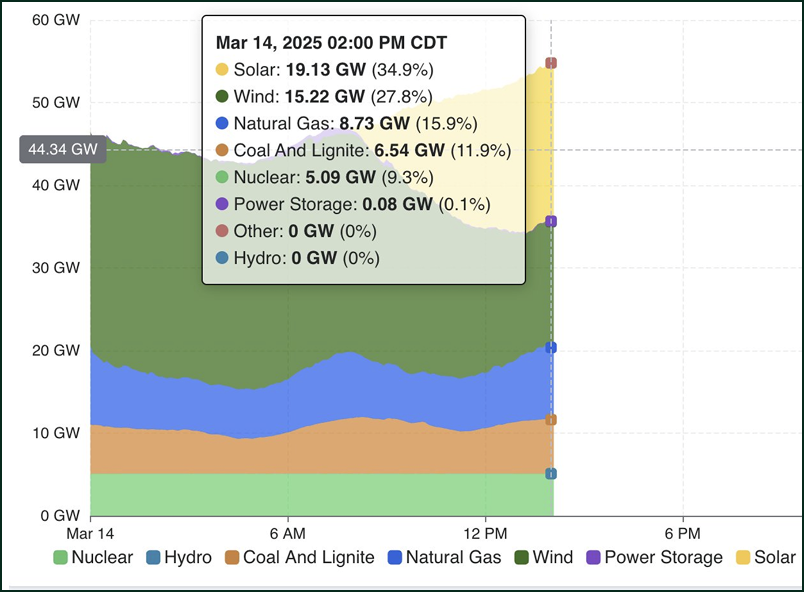
In early March 2025, solar and wind generated 75% of Texas’ electricity. In four years, Texas added over 40,000 MW of solar and batteries, which dwarfs previous records across the U.S. During Winter Storm Uri, prices for electricity in Texas shot up to $1,200 per MWh, far higher than the usual $25/MWh. In 2024, with plenty of solar and batteries on the grid, although Texas experienced extreme weather events, there were no price spikes and wholesale electricity costs remained low. In California, batteries are beating methane gas power plants on cost, and batteries recently added to the grid have helped to keep power prices low. Why? Because solar, wind, and batteries have no fuel costs. In 2023 and 2024, California reduced its methane gas burn for electricity by nearly one-third!
In California, batteries are beating methane gas power plants on cost, and batteries recently added to the grid have helped to keep power prices low. Why? Because solar, wind, and batteries have no fuel costs. In 2023 and 2024, California reduced its methane gas burn for electricity by nearly one third!
One of Third Act’s partners, Energy Sage, has a special program to help Third Actors understand their local solar rules and costs. If you want to dive deeper into solar, Energy Sage has helpful reports here.
Solar, wind, and batteries have no fuel costs. In 2023 and 2024, California reduced its methane gas burn for electricity by nearly one third!

❌ Myth #7: Carbon sequestration will better remove carbon from our atmosphere.
Carbon capture and sequestration, or CCS, is unproven, expensive and risky.
The U.S. has thrown billions of dollars at trying to make CCS work, but the laws of physics—and the cost—show that CCS is a dangerous myth that only allows the fossil fuel industry to continue to dig, frack and burn the future. Experts call it “an unproven dream” that will become a nightmare for investors. There will be delays and technical challenges abound—even for Chevron.
Over 12 years, solar and wind have saved Texans $28 billion in methane gas fuel costs.
❌ Myth #8: Transitioning to green energy will be too slow to have an impact on climate change.
The U.S. Department of Energy under the Biden administration determined that the U.S. needs to add 30 to 60 GW (30,000 to 60,000 MW) of solar per year to meet climate goals. To put this in perspective, the U.S. added 40.5 GW of solar in 2024, thanks to the Inflation Reduction Act. But if we are to avoid the worst impacts of the climate crisis, we must speed up—not slow down—the transition to clean energy. This is why we must hold the line on Trump—so that we can grow 2024’s 50 GW of solar into 60 GW in 2025, and every year thereafter until 2035.
The Solar Energy Industries Association (SEIA) expects the U.S. to add ~45 GW per year annually until 2035, which is ~15 GW short of what we need to add annually to address climate change. If we can hold the line on solar so that the Trump administration doesn’t kill the market, 2024 has shown that the U.S. could easily add 60 GW of solar every year. In 2025, the U.S. Energy Information Administration (EIA) expects over 90% of new electricity sources to be solar, wind, and batteries—not fossil fuels.
And the best news? The benefits of adding solar and wind far, far outweigh the costs in terms of savings on health and environmental damages, water use, and air pollution from burning fossil fuels.
❌ Myth #9: Solar panels will end up in landfills at the end of their lives, polluting the environment.
Contrary to misinformation, solar panels can be easily and effectively recycled.
Solar panels have a lifespan of ~30 years, and as the amount of solar increases, the need for good recycling and end-of-life management increases. If we don’t ensure that solar cells—which can contain lead and cadmium— and other components are properly recycled, we will be adding metals and other toxics to our already-overloaded landfills. The International Renewable Energy Agency (IRENA) estimates that $15 billion worth of solar components could be recycled by 2050. The U.S. National Renewable Energy Lab (NREL) estimates that by 2040, recycled materials could provide 25 to 30% of U.S. domestic solar manufacturing needs.
Solar panel components are made from:
-
- Silicon solar cells
- Metal framing
- Glass sheets
- Wires
- Plexiglas
Glass, metal, and copper wiring are all recyclable and reusable. NREL explains each material’s recyclability, and notes that while silicon cells—the component most essential to producing electricity—are not recyclable like glass and plastic, some specialty recycling companies can reuse silicon cells by melting them down and reclaiming the silicon and various metals within. Technically, all solar panel parts are recyclable materials with the correct process. A 2021 study by NREL explains processes that will make solar systems more easily recyclable, such as glass-to-glass rather than plastic welds. NREL has a number of recent studies that explain solar in a “circular” economy that reuses all possible materials.
There are three broad categories of solar panel recycling:
-
- Re-use: can be used for small-scale applications like powering electric highway signs
- Mechanical: materials are ground down and then used as a building material
- Chemical/thermal: used to extract silver from tiny wires in panels
Europe is far more advanced than the U.S. in solar panel recycling, so we can learn from them. Policies in Europe require manufacturers to recycle panels, while the U.S. is (yet again) a mish-mash of policies and most lack guardrails to require recycling. There are companies in the U.S. that recycle solar panels and components, including Energy Bin, SolarCycle, We Recycle Solar, and Veolia. Parts of wind turbines can also be recycled.
The U.S. National Renewable Energy Lab (NREL) estimates that by 2040, recycled materials could provide 25 to 30% of U.S. domestic solar manufacturing needs.
❌ Myth #10: Renewable energy infrastructure is harmful to animals.
While it is true that wind turbines can kill birds and bats, the problem has been greatly reduced as experts understand how to build turbines so that birds are not attracted to them. Estimates vary quite a bit because data can be hard to find and verify. Research shows that cats, buildings, and cars kill far more birds than wind turbines, with cats killing 200 times more birds than wind turbines.
Renew Economy research estimates that fossil fuels kill 17 times more birds than wind turbines; MIT’s engineering department came to the same conclusion. Renewable energy developers can minimize any harm to animals by carefully selecting where to site projects to avoid issues like being in the flight path of bird migrations.
Bird species are under threat from climate change and a hotter planet, as well as a host of other reasons: habitat destruction, water and air pollution, and changing weather patterns and extreme weather events. Some species have lost an estimated 50% over the past decades, with 3 billion birds lost in North America alone.
Share This


Ways to get involved
All the different ways you can get involved with Third Act: